

Queen looks different - has paint on thoraxthorax:
the middle region of the adult bee body, which lies in between the head and the abdomen; consists of three segments: pro-, meso-, and meta-thorax; thorax attachments include three pairs of legs and two pairs of wings
(see marked queens) or on other parts of body, is smaller sized (see virgin queen) or different coloration or is missing legs/wings or had part of wing missing (see marked queens).
Coloration of body normal or is due to breeding of specific colortion (such as yellow Italian queens) or darker Cape bees. Colortion varitionis normal
There can be considerable variation in queen apprearance. Queens may get injured.
Variation of body coloration normal. Might be due to breeding of specific colortion (such as yellow Italian queens) or from racial mixture (for example darker Cape bees or carniolan or golden Italian queens for example).
Size of queen may vary considerably. Virgin (unmated) and recently mated queens are smaller and thinner in abdomenabdomen:
the segmented, posterior (third) part of the bee body that contains heart, honey, stomach, intestines, Malphigian tubules, reproductive organs, and sting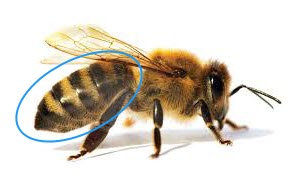 . Queens preparing to swarm will be losing weight and might appear thiner. Queens reared in emergency by colony may be smaller bodied in appearnace. Queens laying fewer eggs (in winter or in colonies with insufficient worker population (after pesticide kill of adults for example or beekeeper splitting of colony) will appear smaller.
Queens may have part of wing cut (as a mark of year reared) or may be missing wing or part of legs (due to injury or from cutting by beekeeper - a technique to promote supersedure).
Queens may lack a retinue, due often to beekeeper opening and smokng of hive in inspection
Some queens "run" away for light when colony opened. Other queens difficult to spot upon colony inspection due to myriad factors.
Variation in body coloration, size, behaviors normal.
Beekeeping Insider https://beekeepinginsider.com/the-three-different-types-of-honey-bees-in-a-hive/
Facchini, Elena, et al.2021. Investigating genetic and phenotypic variability of Queen bees: Morphological and reproductive traits. Animals 113054 Https://doe.org/10.3390/ami11113054
Moore, Philip A., Michael E. Wright and John A. Skinner. 2015. Honey Bee Queens: Evaluating the most important colony member. eXtension Bee Health. https://bee-health.extension.org/honey-bee-queens-evaluating-the-most-important-colony-member/