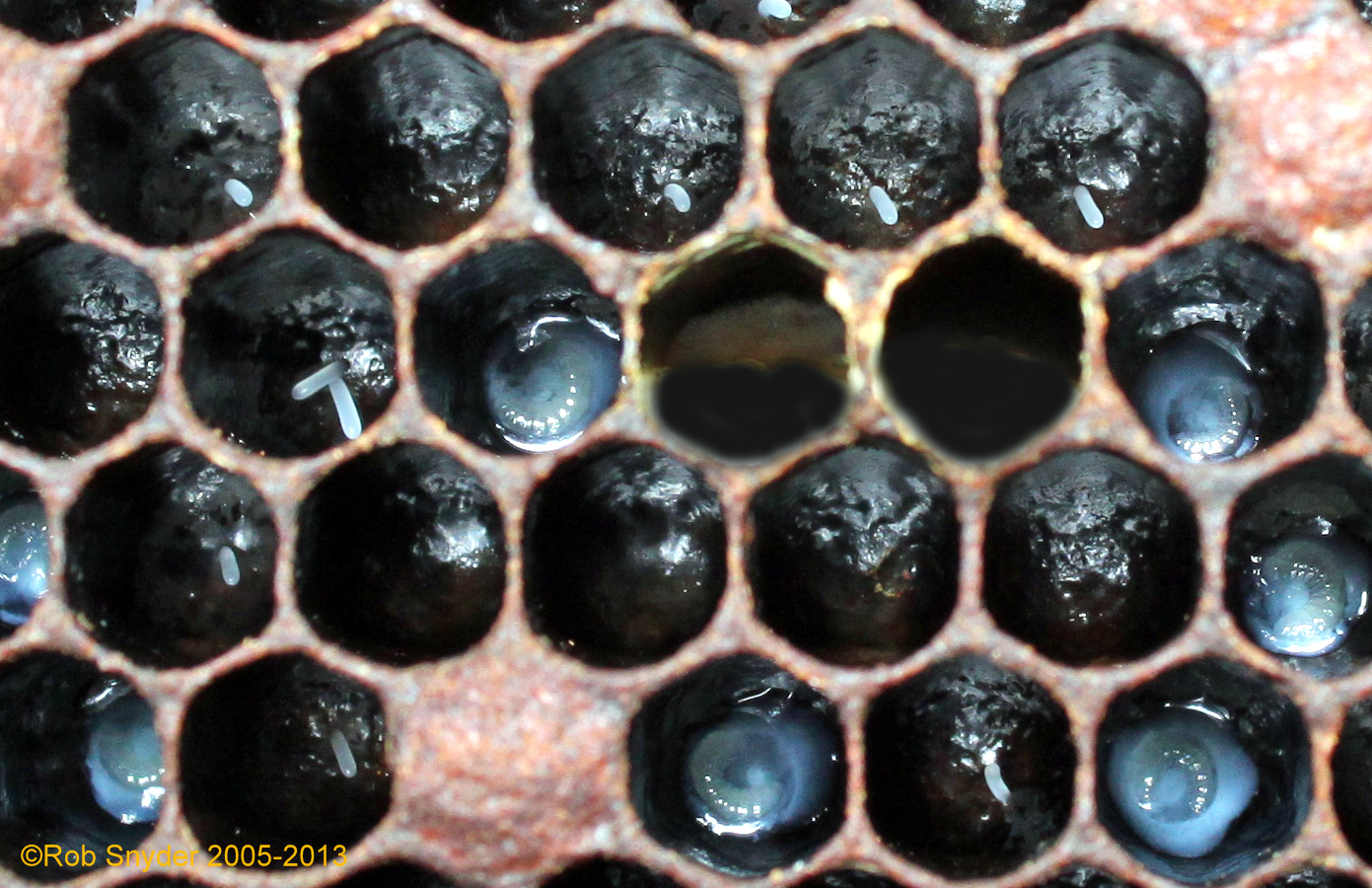
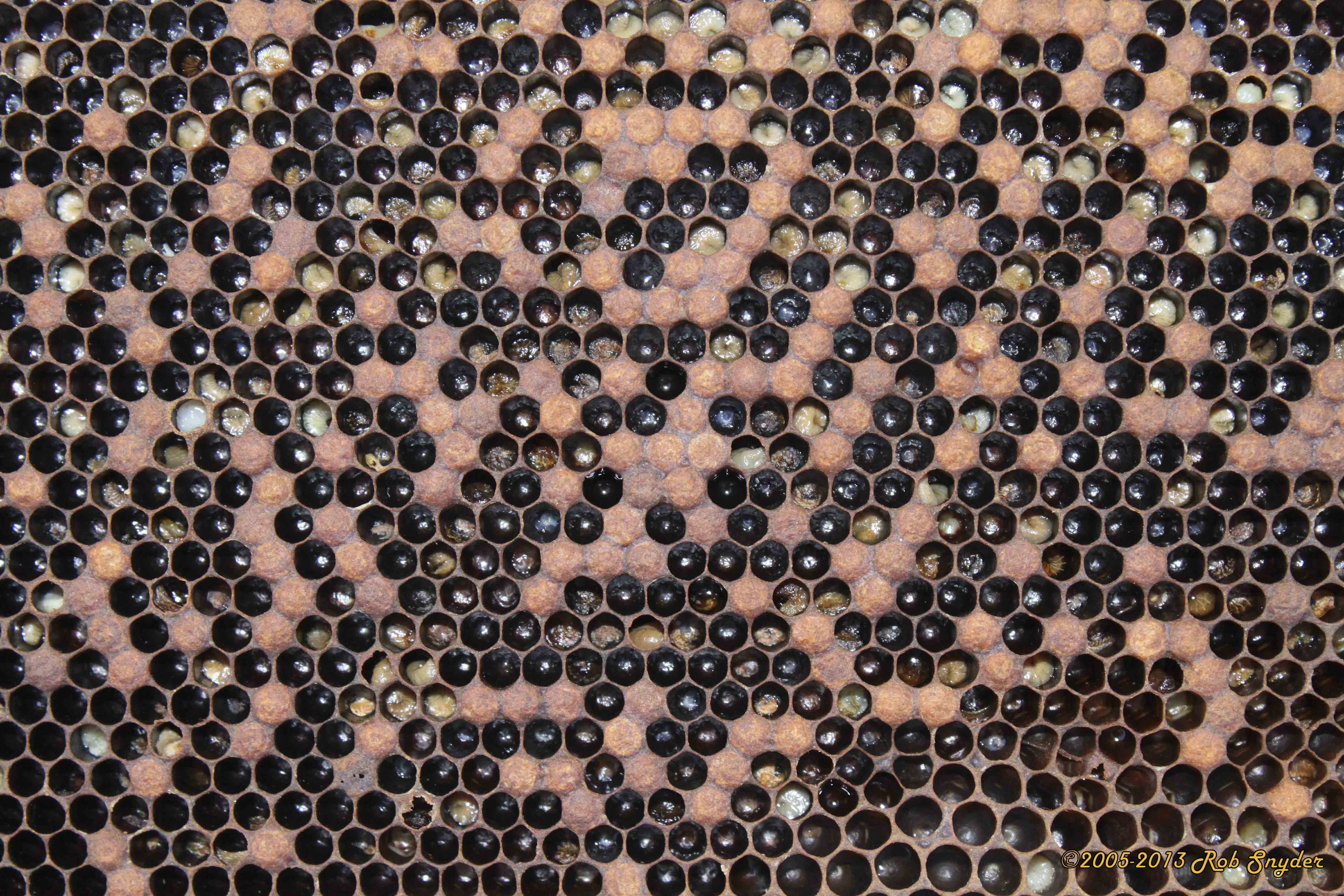
Beeswax comb with egg, larvae or cappedcapping:
the covering that bees add over comb cells containing fully ripened honey or to cap brood that has reached the pupal stage; bee bread cells are not capped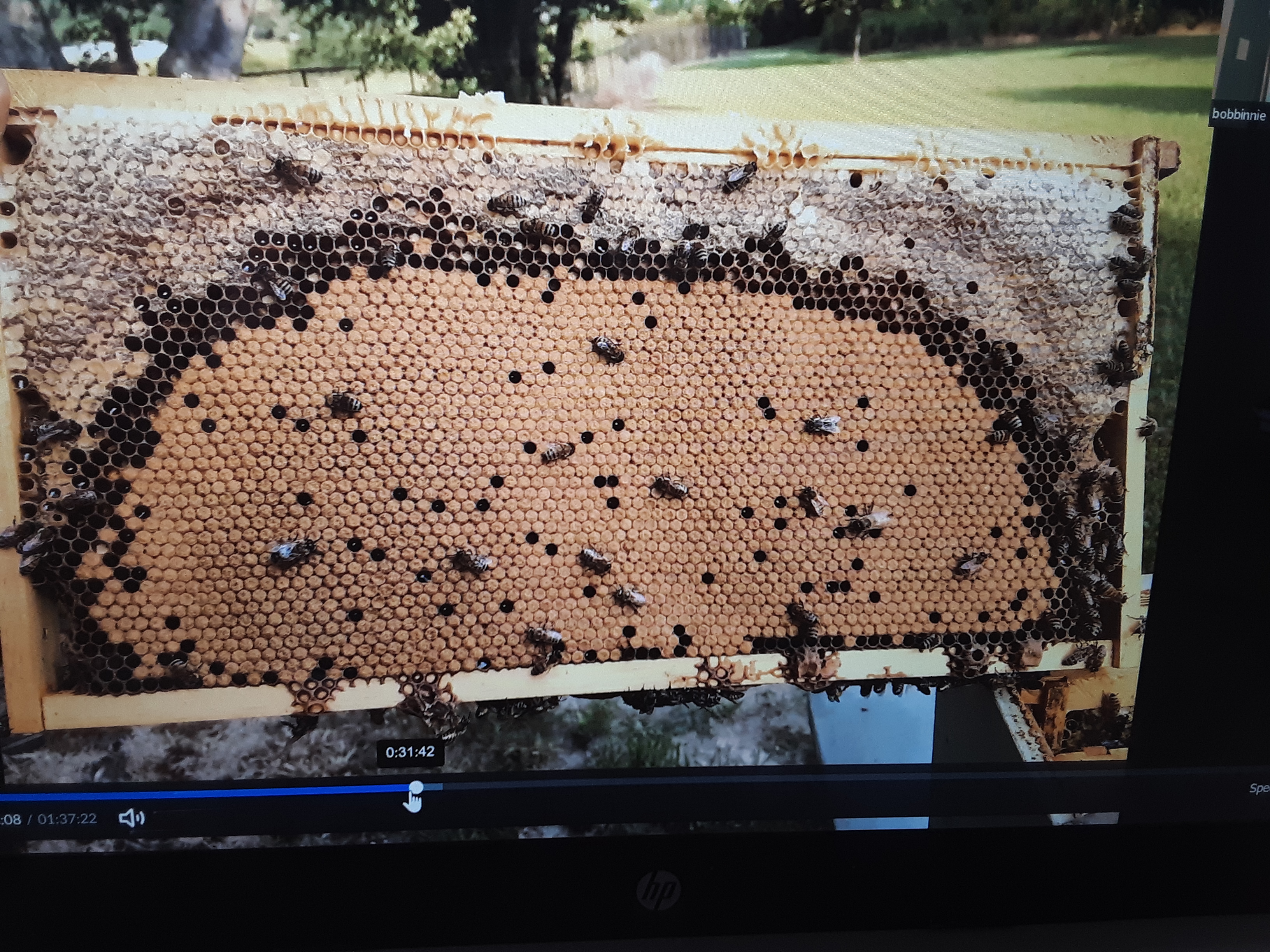 (pupal) stages.
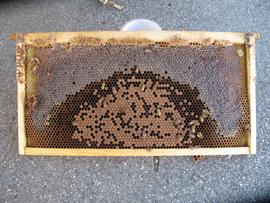
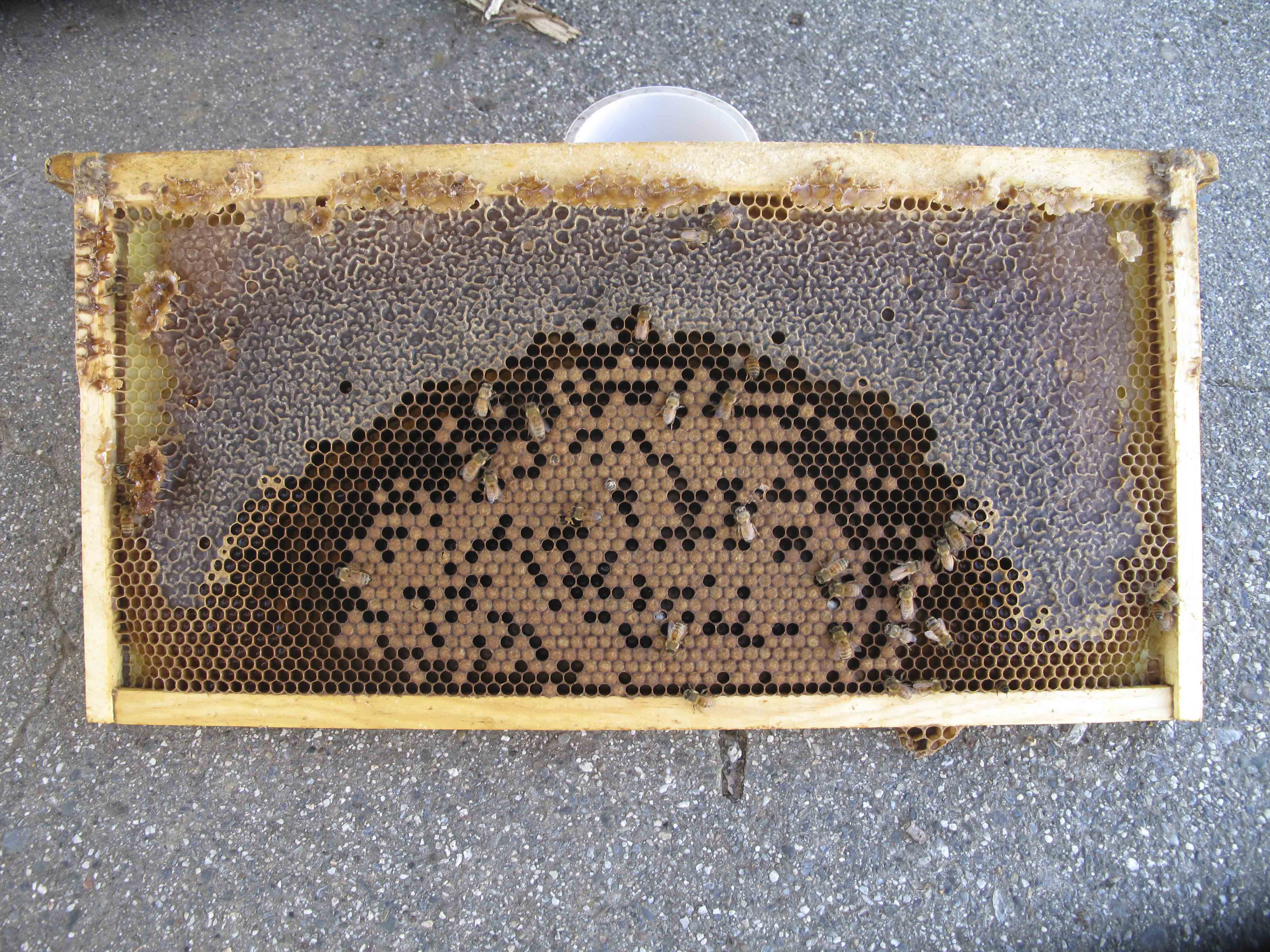
Expect brood pattern to contain brood of same apporximate age in same general area. Brood amount should be adequate for time of season. If pattern spotty, need to diagnose what might be cause.
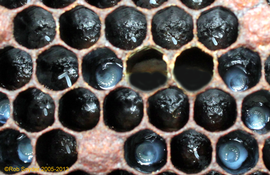
There are three development stages in bees which collectively are known as brood. This entire development takes place in an induvial beeswax cell of the beeswax comb. Bees begin their life in the tiny white egg stage. A queen will deposit one egg in each worker or drone cell. The eggs are about the diameter of a pin and stand on end in their cells. They are very difficult to see. The eggs that will develop into workers are fertilized, while the eggs that will yield drones are not. We cannot tell the difference between fertilized and unfertilized eggs but the bees can. If the queen makes a mistake, the egg is removed and destroyed by worker bees. The egg stage lasts three days.
When an egg hatches it becomes a larva. The bee larva (plural: larvae) is a legless and featureless white grub. It is specialized to eat and never leaves the individual wax cell. Larvae grow at a rapid rate in a five-step development called metamorphosis, increasing 1500 times the original size. The larvae are visited 10,000 or so times during their development by adult nurse bees for inspection, feeding and eventually cappingcapping:
the covering that bees add over comb cells containing fully ripened honey or to cap brood that has reached the pupal stage; bee bread cells are not capped of the cells. Worker bees bring food and place it in the cell. They do not directly feed the larva. The larval development stage for drones is 6.5 days, workers 6 days, and for queens 5.5 days.
When fully grown and filling the cell, the larva changes to a pupa (plural: pupae). The pupal stage, frequently termed cappedcapping:
the covering that bees add over comb cells containing fully ripened honey or to cap brood that has reached the pupal stage; bee bread cells are not capped stage, is one of change. The grub-like larva rapidly takes on the features of the adult. This last stage includes a prepupa form that spins a silken cocooncocoon:
very thin, protective silk envelope which an insect larva or pre-pupa forms about itself by spinning the envelope while inside the cell, to change to the pupal stage
before conversion to the pupal sage (with a day). During the pupal and prepupal stage the cell is sealed with a wax cappingcapping:
the covering that bees add over comb cells containing fully ripened honey or to cap brood that has reached the pupal stage; bee bread cells are not capped. The pupal development stage for drones is 14.5 days, workers 12 days, and queens 8 days. There is variation of several hours to a day or more: for example if brood nest temperature drops, development takes longer. The pupa, once a cocooncocoon:
very thin, protective silk envelope which an insect larva or pre-pupa forms about itself by spinning the envelope while inside the cell, to change to the pupal stage
is spun. does not eat or move.
All bee larvae (female and male) receive royal jellyroyal jelly:
a protein-rich secretion of the worker's hypopharyngeal glands fed to all young bee larvae. Sometimes termed worker jelly to when it is the food fed to the worker larvae for the first three days of worker larval development; the queen receives this food throughout her larval development
after the egg hatches. Royal jellyroyal jelly:
a protein-rich secretion of the worker's hypopharyngeal glands fed to all young bee larvae. Sometimes termed worker jelly to when it is the food fed to the worker larvae for the first three days of worker larval development; the queen receives this food throughout her larval development
is a protein-rich food made in the glands of worker bees and placed in cells just before the egg hatches. Initially the cell with a young larva is mass provisioned. A pool of royal jellyroyal jelly:
a protein-rich secretion of the worker's hypopharyngeal glands fed to all young bee larvae. Sometimes termed worker jelly to when it is the food fed to the worker larvae for the first three days of worker larval development; the queen receives this food throughout her larval development
is kept replenished in the bottom of the cell and the C-shaped larvae simply lie in a pool of its food. After 2.5 to 3 days, however, the diet of the worker and drone larva changes to a mixture of pollen and nectar and food is not so generously supplied. This is called progressive-provisioning. The queen larva remains on a diet of royal jellyroyal jelly:
a protein-rich secretion of the worker's hypopharyngeal glands fed to all young bee larvae. Sometimes termed worker jelly to when it is the food fed to the worker larvae for the first three days of worker larval development; the queen receives this food throughout her larval development
, continued in generous supply, her entire larval life.
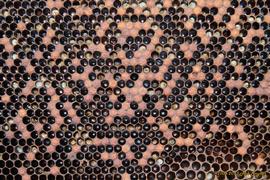
Healthy bees have a brood pattern with most of cells (95%+) filled of developing bees of approximately same age. Percentage may be lower in early spring/later fall. Amount of brood should be adequate for time of season. Brood area should be adequately covered by adult bees to maintain proprer brood reaing temperature (in low 90s F.). We use brood pattern to asess size of adequateness of queen and total brood areas to estimate size of bee colony.
Capped brood might be confused for capped honey; open brood cells may appear empty until clsoely examined with light (and magnifiication) to bottom of cell. Eggs and very early first instar larva very difficut to see.
Spotty or irregular pattern difficult to diagnose
MAAREC (Dewey M. Caron) 2004 rev 2019. Bee Brood. IN Basic Bee Biology for Beeginners. MAAREC Pub. 1.4. https://bee-health.extension.org/bee-brood-basic-bee-biology-for-beekeepers/
Lee, Katie, et al. 2019. Is the brood pattern within a honey bee colony a reliable indicator of queen quality. Insects10:12. doi 10:3390/insects/10010012
Zawislak, Jon. Brood pattern. https://beehealth.uada.edu/assets/pages/broodpattern.html
MAAREC (Dewey M. Caron) 2004 rev 2019. Bee Brood IN Basic bee Biology for Beeginners. MAAREC Pub. 1.4. https://bee-health.extension.org/bee-brood-basic-bee-biology-for-beekeepers/
See worker/drone/queen brood